


2026 Corporate Travel Outlook
Corporate travel enters 2026 with firmer footing, clearer pricing signals, and a more intentional approach to planning. While the global operating environment remains complex, leading industry organizations suggest a year defined by stabilizing demand, steady spend growth and a stronger alignment between travel and business outcomes.
Across industries, travel decision-making is becoming more insight-driven, with organizations placing greater emphasis on high-quality data to inform approvals, budgets and supplier strategy
To help travel managers prepare, we analyzed the latest global research and translated it into practical insights for corporate travel programs in the year ahead.
2026 corporate travel highlights
- Global business travel spend expected to grow 1%
- Budget confidence varies by organization size.
- Airfares stabilizing amid capacity constraints and competitive pressure
- Travel programs shift to value, purpose and capability development
At what pace is global business travel spending forecast to increase by 2026?
The 2026 corporate travel outlook points to steady, moderate spend growth, although momentum varies across regions and company sizes. Insights from Deloitte* and GBTA* indicate that while organizations are increasing budgets, they are doing so with greater scrutiny, prioritizing business travel that directly supports revenue, customer engagement and capability-building goals.
Key insights*
- Global spend continues to rise
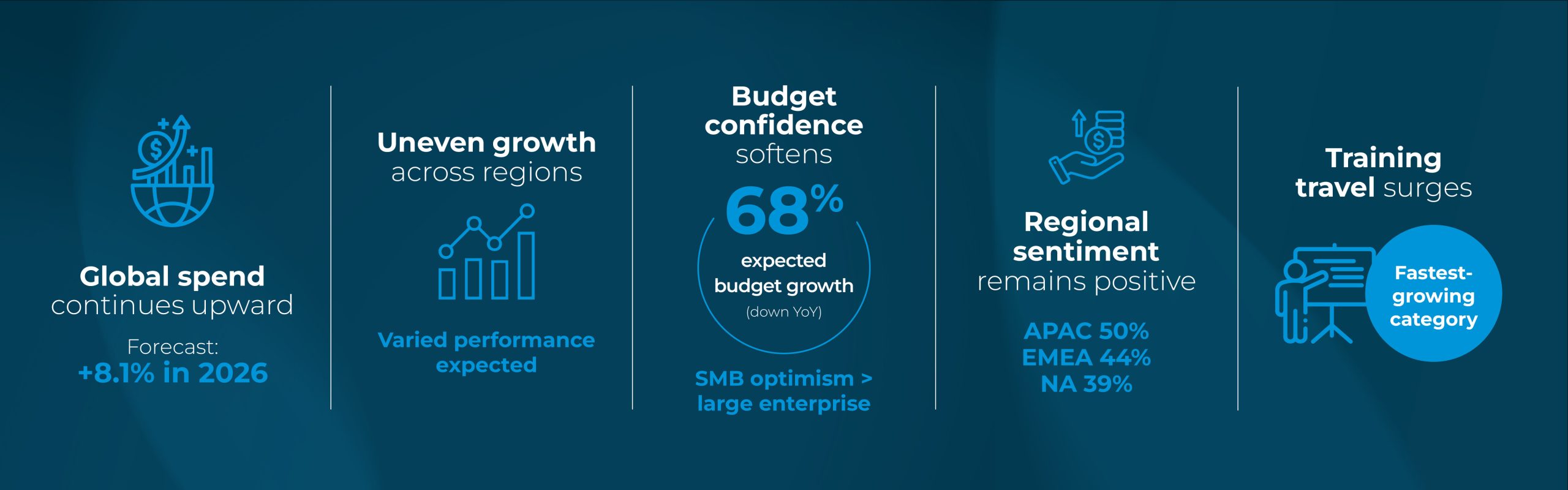
- GBTA’s Business Travel Index forecasted 7% global spend growth in 2025, increasing to 8.1% in 2026, with total business travel spend on track to exceed US$2 trillion by 2029.
- Growth will be uneven across markets
- Regional performance is expected to vary due to macroeconomic conditions, currency movements and differing recovery speeds.
- Differences in economic conditions, exchange rate movements and sector-specific performance continue to shape recovery rates across regions.
- Confidence softens year-on-year but varies significantly by organization size.
- 68% of travel managers globally expect budget growth in 2026, down from 74% entering 2025, signaling more measured investment.
- Large enterprises are more cautious, with 59% expecting 2026 travel budgets to increase and 20% forecasting reductions.
- Small and mid-sized businesses (SMB) show stronger momentum, with 80% expecting budgets to grow as they rely more heavily on travel for business growth.
- Regional sentiment remains broadly optimistic
- Travel buyers anticipating higher spend in 2026:
- Asia Pacific: 50%
- EMEA: 44%
- North America: 39%
- Training and capability-building travel accelerates
- 68% of companies expect learning and development travel to increase, making it the fastest-growing category. This reflects a wider trend toward purposeful travel, prioritizing trips that directly support skill development, customer relationships and long-term growth.
What this means for travel programs
Business travel is firmly re-established as a driver of commercial performance. As organizations review frequency and purpose, 2026 planning requires a sharper focus on trip value, improved visibility of approval processes and more data-driven decision-making.
In this environment, organizations with clearer visibility into their data will be best positioned to manage demand, optimize spend and strengthen the link between travel and business outcomes.
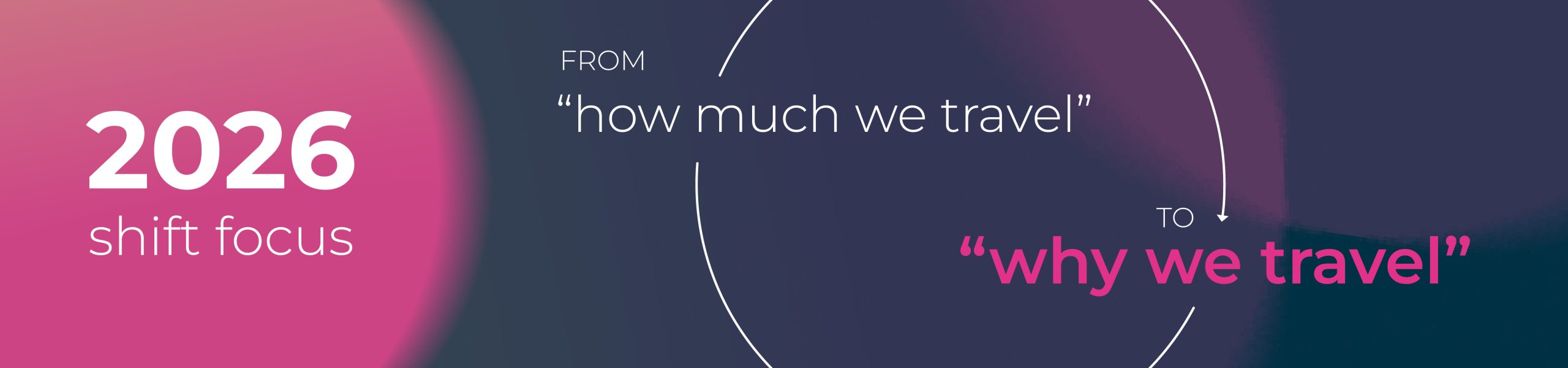
The central question heading into 2026 becomes less about volume and more about: “Why we travel?” What outcomes does our travel deliver?
Will corporate travel prices keep rising, or stabilize in 2026?
Independent forecasts point to a more predictable pricing environment in 2026. Hotels are expected to see modest, steady growth, while air travel remains shaped by a mix of historically low ‘real fares’ and persistent supply constraints. Overall, the 2026 corporate travel outlook indicates more stability than the volatile years immediately after the pandemic.
Air: Stable pricing amid capacity constraints and competitive pressure
- Affordability remains strong. IATA notes the average real return fare in 2025 was US$374, around 40% below 2014 levels. This sets a favorable baseline heading into 2026.
- Aircraft supply remains tight. Backlogs of ~17,000 aircraft continue to restrict rapid capacity expansion and place upward pressure on airline operating costs.
Yet competitive pressure is tempering fare increases. Airlines are balancing elevated costs with softening yields, a price-sensitive corporate segment and increased competition across key markets. Broad-based hikes are unlikely. Instead, expect mostly stable pricing with modest, route-specific adjustments.
Hotels: What’s shaping rates in 2026?
- North America: CoStar and Tourism Economics have revised 2026 expectations downward, with softer average daily rates (ADR) and occupancy growth.
- Asia Pacific: Hotel performance continues to improve, but growth has slowed. ADRs are still increasing due to limited new hotel development and dynamic pricing around events and peak periods even when occupancy is softer.
- UK: The hotel sector enters 2026 with resilience, though elevated labor, energy and supply-chain costs remain. Rate growth (ADR) is expected to be modest.
Across both air and hotel sectors, the prevailing theme is stability rather than significant escalation, giving travel programs clearer signals for 2026 planning.
What this means for travel programs
For travel buyers, 2026 offers a welcome return to better predictability, with hotel rates stabilizing across key markets and airfares remaining broadly steady despite ongoing supply constraints. Competitive pressure, modest rate movements and clearer demand signals allow organizations to plan with greater confidence and shift from reactive cost control to more strategic budgeting and planning.
As pricing is expected to move in small, manageable increments, travel managers can focus on refining supplier strategies, strengthening approval processes and using real-time data more proactively to benchmark performance, identify savings and ensure travel spend aligns with business value and traveler needs.
What should travel managers focus on in 2026?
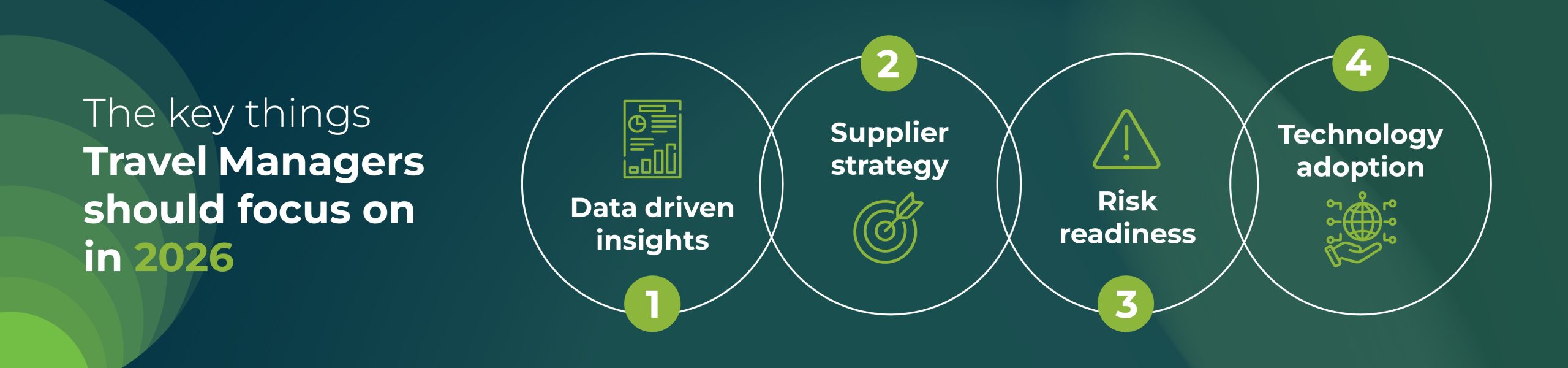
The global travel industry is entering 2026 with momentum, stabilizing costs and a stronger strategic role in business operations. While challenges remain, the outlook from leading global organizations is clear: business travel will continue to grow, evolve and enable commercial outcomes worldwide.
Travel managers who combine:
- data-driven insights
- supplier strategy
- risk readiness
- and technology adoption
will be best positioned to deliver measurable outcomes in the year ahead.
Business travel is expected to continue its steady upward trajectory, but with more disciplined budgeting and a stronger focus on measurable value. While volatility persists in some markets, the broader trend is stabilization, supported by clearer pricing signals, maturing demand and more informed travel forecasting.
Plan your 2026 travel strategy with confidence.
Talk to us to explore how your travel program can get ahead in 2026.
What is a corporate traveler well-being strategy?
A corporate traveler well-being strategy is an approach to business travel that prioritizes employee health, comfort, and mental well-being across the entire travel journey. It considers factors such as travel frequency, scheduling, accommodation quality, recovery time, and emotional support to reduce stress and fatigue while improving productivity and engagement.
Why is traveler well-being important in corporate travel programs?
Frequent business travel can lead to fatigue, stress, and burnout if not managed carefully. Prioritizing traveler well-being helps organizations protect employee health, improve job satisfaction, increase productivity, and support long-term retention, while still meeting business objectives.
How can companies reduce travel-related stress for employees?
Organizations can reduce travel stress by minimizing last-minute bookings, limiting red-eye and frequent overnight trips, managing time-zone impacts, allowing flexible schedules, and providing adequate rest and recovery time. Using travel data to identify high-risk travel patterns also enables proactive intervention.
How does technology support traveler well-being?
Travel technology can track factors such as trip frequency, time-zone changes, long-haul travel, red-eye flights, and travel during personal time. Tools like well-being scores analyze these patterns to provide insights into traveler fatigue and forecast future well-being, helping travel managers make informed, supportive decisions.
What role do travel managers play in employee well-being?
Travel managers help shape a culture of care by designing travel programs that balance business needs with employee health. This includes selecting comfortable airline and hotel partners, setting travel guidelines that reduce fatigue, and collaborating with HR and risk teams to support mental, physical, and emotional well-being.
How can organizations support work-life balance for traveling employees?
Supporting work-life balance may include flexible working hours while traveling, allowing downtime, encouraging connection with family, and permitting employees to extend business trips for personal travel where appropriate. These measures help travelers feel more supported and less disconnected.
What should happen after a business trip to support recovery?
Post-trip support can include allowing recovery time after long-haul or overnight travel, monitoring ongoing travel patterns for signs of burnout, and adjusting future travel schedules to prevent fatigue and maintain long-term well-being.