


Part 1: Evaluating the value of your corporate hotel program
Creating a corporate hotel program the deliever value seems simple, right? Well, what if we told you, according to STR, there are approximately 800 hotel chains representing more than 1,300 hotel brands worldwide?
So, with so many hotels to choose from and more in the pipeline, it has never been more important to use the expertise of a travel management company to navigate this rapidly evolving sector to get the biggest bang for your buck and meet the diverse needs of your travelers.
Accommodation is a key part of travel spending, and Corporate Travel Management (CTM) has the technology and expertise to help you accurately identify savings opportunities. At CTM, we invest heavily in developing tools and services that maximize savings, including access to pre-paid last-minute hotel inventory and tactical supplier negotiations. Our account management teams work closely with you to understand what service offerings you consider valuable to your business and employees, as this can vary greatly.
What does hotel program value mean?
Organizations need to understand what they deem valuable from a hotel service offering. This does not always solely come down to achieving the lowest possible rate available at the risk of the standard of facilities, level of service, location, amenities or value-adds. Considering the well-being of travelers may also be valuable to ensure they are well-rested, enabling them to carry out the intended purpose of travel most effectively and productively, often delivering greater returns.
How do I decide what type of accommodation is best for a corporate hotel program?
With so much choice, deciding what “type” of accommodation solutions are required to service your travelers’ needs is critical. Full-service, self-catering, chain, and independent boutique hotels all offer different guest experiences, each valuable but not necessarily suitable for every business or traveler.
The CTM Global Hotel Program allows customers to take advantage of CTM’s global buying power, with more than 52,000 properties in over 200 countries participating, offering discounts, benefits, and flexibility. CTM is witnessing a trend of more customers designing their accommodation program around the offering, especially for locations that have infrequent travel volumes and don’t necessitate a negotiated rate. By leveraging the CTM Global Hotel Program, customers often achieve lower average daily rates.

How do strategic hotel partnerships and traveler feedback create value?
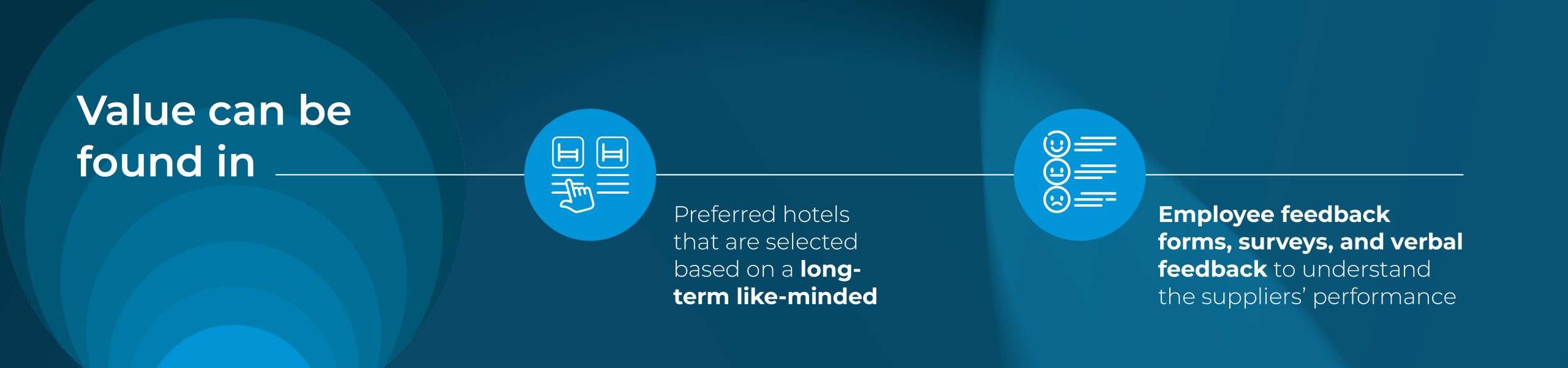
Value may also be found in preferred hotels that are selected based on a long-term like-minded partnership where they are working towards achieving common goals, such as sustainability, or based on reciprocal business benefits.
As an example, CTM supported an FMCG customer by creating a bespoke identifier in Lightning, CTM’s proprietary online booking tool, to identify hotels that stocked their products. This allowed the organization’s travelers to make informed buying choices based on reciprocal business with the customer. This improved their partner hotel attachment rate and demonstrated value back to their business to help their future commercial discussions.
Value can also be found through listening to what travelers deem important. Employee feedback forms, surveys and verbal feedback are a great way to understand the performance of your current suppliers’ value and suitability for their intended purpose.
How does consolidating hotel spend benefit your preferred program?
Whether it be corporate, groups, projects, long-stay or bleisure travel, consolidating all types of business travel under a common hotel program and policy will help increase buying power. Some organizations are using this buying power not only to achieve cost savings but also to increase the quality of hotel selection for a better traveler experience. Corporates are focused on taking the friction out of business travel to make it an enjoyable, aspirational experience and a positive component of the employee value proposition, which is critical to the retention of employees.
Is location and length of stay an important factor to consider when selecting hotels?
The consideration of location is also important. This can be the proximity of hotels to regional offices, project sites, customers’ offices, or conference and event venues. The ability for business travelers to walk or take public transport eliminates incidental expenditure of ride-share, taxis or private transfers, providing cost savings back to the business and reducing their carbon footprint. Length of stay can also be considered when measuring value. For an extended stay, utilizing apartment-style accommodation with home comforts, such as a kitchen, washing facilities, and more space to work, may be a better solution than traditional hotel accommodation.
How does duty of care influence hotel selection?
Where the duty of care is paramount, consideration of hotel security features, including 24-hour reception and dedicated floor swipe access, may be incorporated as a mandatory requirement. In addition, confirmation of security cameras on each hotel floor and car park may also be a consideration to support safety and security in hotel public areas.
How do you find value in corporate hotel programs beyond savings?
As many organizations look to review their preferred hotel suppliers and the effectiveness of their hotel program, remember to look beyond cost savings. While maximizing your travel budget is important, doing so at the risk of traveler comfort, safety, security, and productivity may have larger implications for your organization. Work with your travel management company to reap the rewards of their relationships, influence, and expertise. Their knowledge of hotel products and their understanding of your business will deliver you a hotel program that not only increases hotel attachment and reduces out-of-policy bookings, but also where you will find the true meaning of “value”.
Read Part 2: How to measure the sucesss of a corporate hotel program
Want to maximize the value of your corporate hotel program?
Contact CTM to explore customized solutions that align with your company’s goals.
What should travel managers look for when assessing hotel program value?
Travel managers should look beyond room rates and consider how well the hotel program supports traveler needs, business locations, safety requirements, and consistency across markets, while aligning with internal travel policies.
Is a cheaper hotel rate always better value for a corporate travel program?
Not necessarily. Lower rates can reduce value if they compromise location, availability, traveler comfort, or safety. True value balances cost with productivity, wellbeing, and risk management.
How does hotel availability affect the value of a corporate hotel program?
Limited availability in key cities can force travelers to book outside the program, reducing policy compliance and negotiated benefits. A valuable hotel program prioritizes coverage where travelers actually travel.
What role does traveler choice play in hotel program value?
Offering appropriate choice within policy encourages compliance and improves traveler satisfaction, helping organizations maximize the value of their negotiated hotel arrangements.
How does risk management influence the value of accommodation programs?
Accommodation that meets safety, security, and duty of care requirements reduces exposure during disruptions or emergencies, adding value by protecting both travelers and the organization.
Can hotel programs deliver value for both short and extended stays?
Yes. A high-value hotel program includes a mix of accommodation types to support different trip durations, ensuring comfort and suitability without sacrificing control or visibility.